Trust Boundary Scenarios
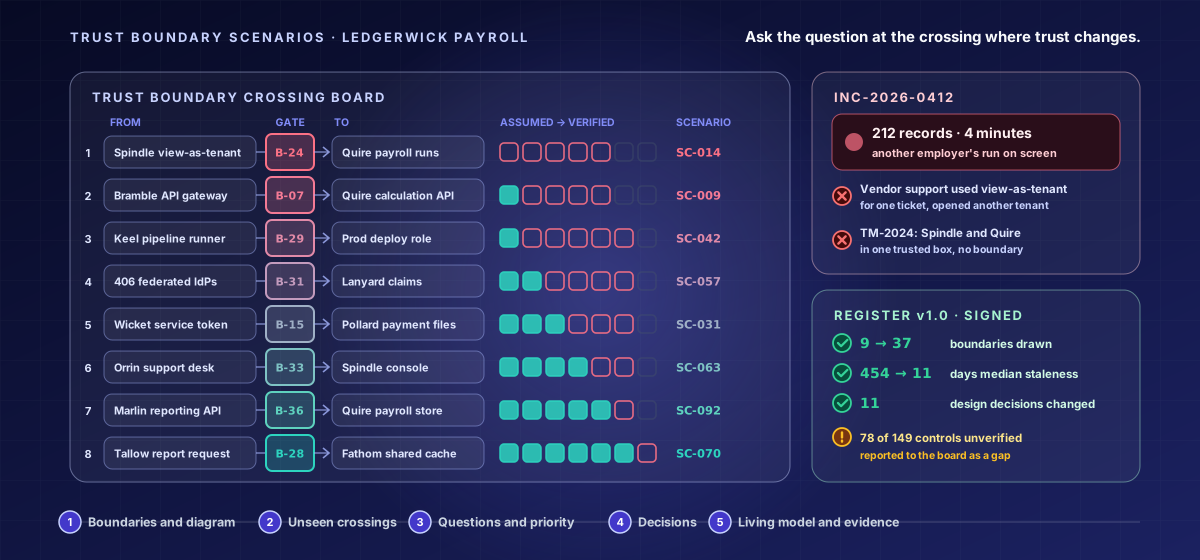
An expert-level threat modelling course on designing scenarios that find the trust boundary problems which matter, rather than a long generic threat list. Work down the Trust Boundary Crossing Board - eight rows, one per chapter: what a trust boundary is and why serious flaws sit on one; drawing the data flow diagram at the level where boundaries show; the boundaries nobody draws - admin planes, tenants, CI and production, identity providers and vendor support access; scenario design as a disciplined question at each crossing, with STRIDE as a prompt; priority by consequence and control confidence; turning each priority scenario into a design decision, a test or an owned risk; keeping the model alive through change; and evidencing it to an architecture board by the decisions it changed.
What you'll learn
- Explain what a trust boundary is, test an existing threat model against real failures, and write a purpose statement measured by decisions changed.
- Draw data flow diagrams at the level where every change of principal, privilege or data owner is visible, and build a boundary inventory of caller, callee, credential and data.
- Draw the boundaries diagrams leave out: a service and its admin plane, tenants in shared storage, CI and production, federated identity providers, and vendor support access.
- Design scenarios by asking what is assumed, what is verified and what happens if the assumption is wrong at every crossing, using STRIDE as a prompt and naming the control that must hold.
Sign in to enrol — you can pay by bKash or Nagad, or apply a promo code.