Threat Modeling at Scale — The Trust Boundary Loop
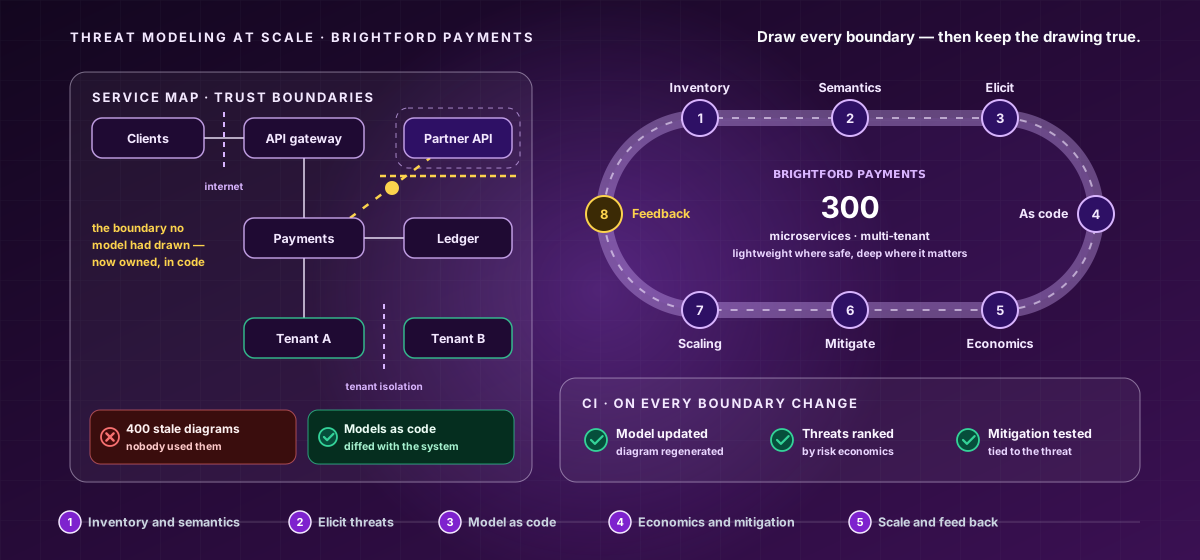
An expert-level, program-optimisation course in threat modeling at scale, centred on trust boundaries: inventorying every boundary across hundreds of services from the real service catalogue and dependency graph, making each boundary's enforcement and assumptions explicit, eliciting threats systematically across crossings, encoding models as pytm/threagile-style code that diffs and gates in CI, ranking threats by risk economics rather than a single brittle score, matching and verifying mitigations against real running controls, scaling the practice with tiered depth, templates, and champions, and closing the loop with feedback from incidents and authorized own-environment testing. Work the Trust Boundary Loop's eight disciplines as principal security architect at a 300-microservice fintech platform. Four hands-on activities in every lesson.
What you'll learn
- Inventory every trust boundary across a large, multi-service estate from the real service catalogue and dependency graph, with an owner on every boundary.
- Make each boundary's actual enforcement and assumptions explicit, and trace identity and token scope as they propagate across crossings.
- Elicit threats systematically across boundary crossings with STRIDE, attack trees, LINDDUN, and defensive use of ATT&CK/CAPEC, and encode the resulting models as version-controlled, CI-gated code.
- Rank threats by real risk economics, design and verify mitigations matched to boundary type against running controls, scale the program by tiered depth, and close the loop with feedback from incidents and authorized testing.
Sign in to enrol — you can pay by bKash or Nagad, or apply a promo code.